

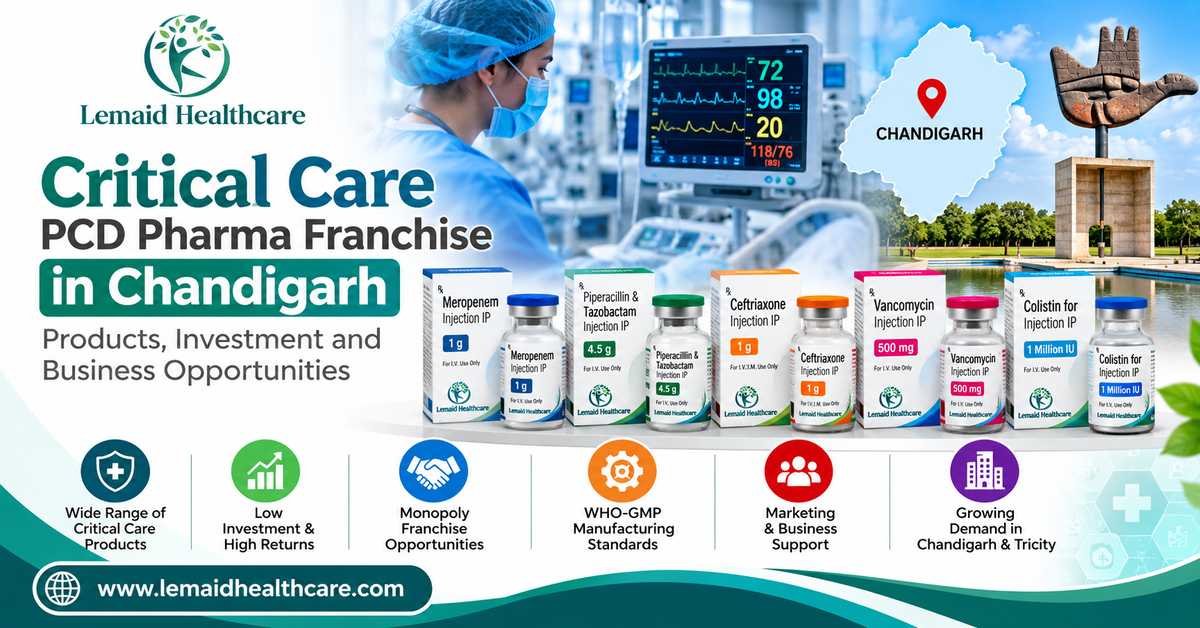
Most people starting out in pharma pick a general range, because that’s what everyone else does. Critical care rarely comes up in those early chats. You won’t see these injections in chemist shop windows, and nobody walks in asking for a meropenem vial by name. But every ICU, casualty ward and operation theatre goes through them day after day, and a hospital that runs short of them is in real trouble. That steady, unglamorous demand is what makes this segment interesting for distributors.
Chandigarh is a good place to look at it. Hospitals here are busy all year, new nursing homes keep opening, and most pharma traders in the city already know how PCD works. So if you’ve been weighing up a Critical Care PCD Pharma Franchise in Chandigarh, this is our attempt to answer the questions people usually bring to us about products, licences, money, monopoly and how to pick a company you won’t regret.
What Is a Critical Care PCD Pharma Franchise?
PCD stands for Propaganda Cum Distribution. The company makes and packs the medicines under its own brand, and you get the right to promote and sell them in an agreed area. You don’t need a factory or your own product approvals. Your job is the market.
In critical care, that market is mostly hospitals. Think of the ICU, the casualty ward, the OT, and those nursing homes that have squeezed in four or five ICU beds of their own. Your days go less into chemist shops and more into hospital pharmacies, chatting with the pharmacist, the purchase manager and now and then the surgeon or anaesthetist. Almost everything you sell will be an injection, because patients this unwell often can’t take tablets.
Hospital buying also works a little differently from a chemist counter. Many hospitals keep a list of approved vendors, raise proper purchase orders and expect every invoice and batch record to be in order. If you’re comfortable with that kind of paperwork, a critical care pharma franchise in Chandigarh can be a very steady business.
Why Chandigarh Is a Good Market for a Critical Care Franchise
For a city of its size, Chandigarh has a surprising number of hospitals. PGIMER and the government hospitals in Sector 32 and Sector 16 pull in patients from far outside the city, and over the years a whole ring of private hospitals and nursing homes has come up around them. Plenty of those patients need an ICU bed, a surgery or a few days on a drip before they go home.
It’s worth being honest about one thing, though. The big government institutions mostly buy through tenders and rate contracts, so a new PCD partner won’t simply walk in and start supplying them. Where you’ll really do business is with private hospitals, nursing homes, day-care surgical centres and the hospital pharmacies attached to them. There are plenty of those in and around the city, and they buy critical care injections every single week.
The city also makes the practical side easy. The roads are good, distances are short, and you can cover most of your customers in a day. Stock can reach a hospital the same day it’s ordered, which matters a lot in this segment. All of that makes Chandigarh a sensible base for a critical care PCD pharma franchise in Chandigarh that wants to grow slowly and steadily.
Benefits of a Critical Care PCD Franchise in Chandigarh
Why would anyone pick critical care over an easier general range? Partners who’ve done it usually give us the same few reasons, and a Critical Care Injection PCD Franchise in Chandigarh has all of them.
Bigger Orders From Fewer Customers:
One busy private hospital can order more in a month than five or six chemist shops put together. So you don’t need a hundred customers. Ten or fifteen good hospitals and nursing homes can be a proper business.
Orders That Come Back Every Week:
Hospitals don’t stop using antibiotics in winter or pantoprazole in summer. Once your brand is on their list, the reorders keep coming, week after week, and you’re not chasing new buyers every month.
Higher Value Per Visit:
A vial is worth a lot more than a strip of tablets. Same visit, same petrol, same half-hour waiting outside the pharmacy, but a much bigger bill at the end of it.
Loyal Buyers:
Hospital staff don’t like changing what they use without a good reason. If your quality holds and your deliveries are on time, they’ll stick with you for years.
Critical Care Products to Start With
You don’t need fifty products on day one. What most of our partners carry first is a handful of antibiotic injections, something for acidity, something for vomiting, and iron and B12 injections. That covers most of what a private hospital orders week to week, and it’s a sensible first list for any critical care PCD franchise in Chandigarh. Here’s what that looks like in the Lemaid Healthcare range.
| Product | Composition | Used For |
|---|---|---|
| MEROSOFT-1000 | Meropenem 1000 mg | Severe and resistant infections, sepsis |
| TAZOLEM-4.5 GM | Piperacillin 4 g + Tazobactam 0.5 g | ICU pneumonia, abdominal infections, sepsis |
| TAZOLEM-2.25 GM | Piperacillin 2 g + Tazobactam 0.25 g | Serious bacterial infections |
| LEMZONE-S 1.5 GM | Cefoperazone 1000 mg + Sulbactam 500 mg | Serious hospital infections |
| LEMCEF-1.5 GM | Ceftriaxone 1000 mg + Sulbactam 500 mg | Hospital infections, after surgery |
| LEMCEF-1 GM | Ceftriaxone 1000 mg | Infections and infection prevention before surgery |
| LEMCEF-S 375 | Ceftriaxone 250 mg + Sulbactam 125 mg | Bacterial infections |
| PANTALEM-40 IV | Pantoprazole 40 mg | Acidity and ulcer prevention in admitted patients |
| RABILEM 20 | Rabeprazole 20 mg | Acid problems in patients who can’t take tablets |
| VOMILEM | Ondansetron 2 mg/ml (2 ml ampoule) | Vomiting after surgery or chemotherapy |
| FERILEM-100 | Iron Sucrose 100 mg | Iron deficiency anaemia |
| COBALEM-2500 | Methylcobalamin 2500 mcg | Vitamin B12 deficiency and nerve support |
In our experience, ceftriaxone injections and pantoprazole sell the fastest, and ondansetron isn’t far behind. The piperacillin and meropenem vials are bigger-ticket items. They tend to pick up once the ICU staff at a hospital have seen you turn up regularly for a few months. Of course, all of these are prescription medicines, so your job is to keep them available, not to push them.
How to Start a Critical Care PCD Pharma Franchise in Chandigarh
Start with a list, even a rough one in a notebook. Put down the private hospitals in your area, then the nursing homes that have ICU beds, then any surgical or day-care centres. Then go and meet the people who run their pharmacies. Find out what they go through quickest. Whose brands are they buying now? Has any supplier let them down lately? And ask whether there’s a vendor list you’d need to get on.
While you’re doing those rounds, apply for your drug licence, since it can take a few weeks to come through. The licensing office will want to see a clean, dry storage room that stays out of the sun. They’ll also need a registered pharmacist, or someone with the right experience, named on the application.
After that, speak to two or three companies with a decent injectable range. Get their lists and rates, look at their certificates, ask for a few sample vials, and ask them straight how many days they take to dispatch. When you settle on one, read the agreement properly. Products, area, payment terms, delivery time, expiry and replacement policy and how long the deal runs should all be in it.
Don’t start with everything. A couple of ceftriaxone injections, pantoprazole and ondansetron are usually enough to open doors. Add meropenem and piperacillin later, once the hospital knows you and trusts your stock. A Critical Care PCD Pharma A franchise in Chandigarh is built one hospital at a time, and the partners who do well are the ones who never let a regular customer run dry.
Investment, Drug Licence and Documents
How much money do you need? Honestly, there’s no single figure for a critical care PCD pharma franchise in Chandigarh. It moves with the number of products you take, how much of each, the company’s minimum order, freight and what you spend fixing up your storage room. One thing catches new partners off guard. Vials cost a lot more than tablets, so even a small first order can look big on the invoice.
Plan for credit from day one. Hospitals and nursing homes often pay after 30 to 60 days, sometimes longer, while the company wants payment for your next order on time. Keep enough working money aside so that one slow-paying hospital doesn’t stop you from restocking another.
On the licence side, you’ll need a wholesale drug licence, which is normally issued on Forms 20B and 21B. For Chandigarh, you apply to the drug licensing office of the Chandigarh Administration. If it’s your first time, a local consultant can save you a few trips. Some ICU products come with extra legal controls, so if you ever plan to stock those, check with the office first.
Paperwork-wise, keep your drug licence, GST number, ID and address proof, and the rent agreement or property papers for your shop or godown handy. Once orders start, file every bill and batch record properly. Hospitals ask for them, inspectors ask for them, and it’s a pain to dig them out later. We also suggest keeping copies of your company’s manufacturing licence and quality certificates in the same file.
Monopoly Critical Care PCD Pharma Franchise in Chandigarh
Some companies offer monopoly rights, which means they won’t appoint another partner to sell the same products in your area. Other brands can still sell there, so monopoly protects you from your own company’s partners, not from the whole market.
In critical care, that protection is worth having. It can take you months of visits to get one hospital to put your brand on its list. Under a Monopoly Critical Care PCD Pharma Franchise in Chandigarh, nobody else from your own company can walk in after you and offer that hospital a cheaper rate. The work you put in stays yours.
Before you sign, sit down with the company and go through the details. Which area exactly? All products or just some? How many years, and how does renewal work? Is there a monthly target, and what happens in a slow month? Could they ever appoint someone else in your area? Get every answer in writing. And remember that monopoly doesn’t guarantee hospital orders. You still have to win each hospital on quality, price and service.
Critical Care Franchise in Chandigarh, Mohali and Panchkula
People here talk about Chandigarh, Mohali and Panchkula as if they’re one city, the Tricity, and on the road it does feel that way. You can visit hospitals in all three in a single afternoon. On paper, though, each one is separate, and that matters when you plan a Critical Care PCD Pharma Franchise in Tricity.
| Area | What to Know |
|---|---|
| Chandigarh | Big government hospitals plus many private hospitals and nursing homes. Most PCD business comes from the private side. |
| Mohali | A fast-growing set of large private and super speciality hospitals, with steady ICU demand. |
| Panchkula | Private hospitals, nursing homes and a busy pharma trade, with easy access from Chandigarh. |
The thing people miss is licensing. Mohali and Panchkula each have their own state drug office, separate from Chandigarh’s. A licence from Chandigarh won’t automatically cover a godown in either of the other two, so check before you start supplying there. Territory rights are the same story. A monopoly for Chandigarh doesn’t cover Mohali or Panchkula unless the agreement says so in writing.
How to Choose the Right Critical Care PCD Company
Quality comes before everything else in this segment. A hospital that gets one bad batch from you may never order again, and word travels fast between pharmacists. Ask where the products are made and read the WHO-GMP certificate yourself, date and all. Antibiotics like ceftriaxone and piperacillin should come from a separate production block, so ask about that too.
Then hold a vial in your hand and have a proper look. The powder should be dry and even, the seal untouched, and you shouldn’t have to squint to read the batch number or expiry. A pack that comes with its own sterile water ampoule is a small thing, but nurses on a busy shift notice it.
Supply is the next big question. A hospital won’t wait for a supplier who runs out. Go out of stock for even a few days and the pharmacy will buy another brand, which might quietly become their regular one. So ask the company how quickly an order actually leaves their warehouse, and what they do when you call with something urgent.
Look at the range and the terms as well. The more of a hospital’s regular order one company can cover, the fewer suppliers you have to juggle. Ask for rates, minimum order, freight, payment terms and the expiry return policy on paper, not just over the phone. And if territory matters to you, ask plainly whether they offer a Critical Care PCD Pharma Franchise with Monopoly Rights in Chandigarh and on what terms.
Why Choose Lemaid Healthcare in Chandigarh?
Lemaid Healthcare is based in Panchkula, a short drive from Chandigarh, so stock doesn’t have to travel across the country to reach you. When a hospital needs a quick refill, that closeness really helps. We’ve built our injectable range around what private hospitals and nursing homes here actually reorder, and most of our antibiotic vials come packed with their own sterile water.
Partners get monopoly-based rights in their allotted area, along with promotional support and help from our marketing team. If you’re looking for a Critical Care PCD Company in Chandigarh with a ready injectable range and quick supply, call or message our team for the full product list and rates, and to check whether your area is available.
Conclusion:
Critical care won’t win any prizes for being exciting, but as businesses go, it’s about as steady as pharma gets. Hospitals need antibiotics, acidity injections and anti-vomiting medicines every week, in every season. And Chandigarh, with its busy private hospitals and short distances, is an easy city to build that kind of business in.
It isn’t a lazy business, though. Hospitals expect good quality, quick delivery and clean paperwork, and you’ll need some patience while they take their time paying. If you’re taking monopoly, get it written down properly.
Our best partners all started small. A few hospitals, a few injections, never running short, and then slowly adding the bigger antibiotics as trust grew. A year or two of that and you’ve got a list of hospitals that simply call you when they need stock.
If you’re ready to start a Critical Care PCD Pharma Franchise in Chandigarh, Lemaid Healthcare would be glad to work with you. With a ready critical care injectable range, monopoly-based rights and supply from right next door, our team can help you plan a first order that suits the hospitals in your area. Reach out for the product list and rates.
Frequently Asked Questions:
Q.1 What is a critical care PCD pharma franchise?
Ans. It’s where a pharma company lets you sell its critical care injections under its brand in your area. They make and pack everything. You look after the hospitals and nursing homes and keep them stocked.
Q.2 Is Chandigarh a good place to start a critical care franchise?
Ans. Yes. There are lots of private hospitals and nursing homes, patients come from far and wide, and you can deliver anywhere in the city the same day. Just keep in mind that your business will mostly come from private hospitals, not the big government ones.
Q.3 Which critical care injections sell the most?
Ans. Ceftriaxone injections, pantoprazole and ondansetron usually move fastest. Piperacillin-tazobactam and meropenem pick up once ICUs start trusting your supply.
Q.4 Which licence do I need?
Ans. A wholesale drug licence, usually on Forms 20B and 21B, from the drug licensing office of the Chandigarh Administration. You’ll need GST registration and a proper storage room too.
Q.5 How much investment is needed?
Ans. It depends on how many products you take, the quantities and the company’s minimum order. Keep extra money aside, because hospitals often pay after 30 to 60 days.
Q.6 Can I get monopoly rights in Chandigarh?
Ans. Yes. Lemaid Healthcare offers monopoly-based rights in the allotted area, subject to availability. Whichever company you choose, get the area, products, time period and any target written into the agreement.
Q.7 Can I supply Mohali and Panchkula with a Chandigarh licence?
Ans. Not automatically. Mohali and Panchkula come under different state drug offices, so check what your licence and premises allow before supplying there.