

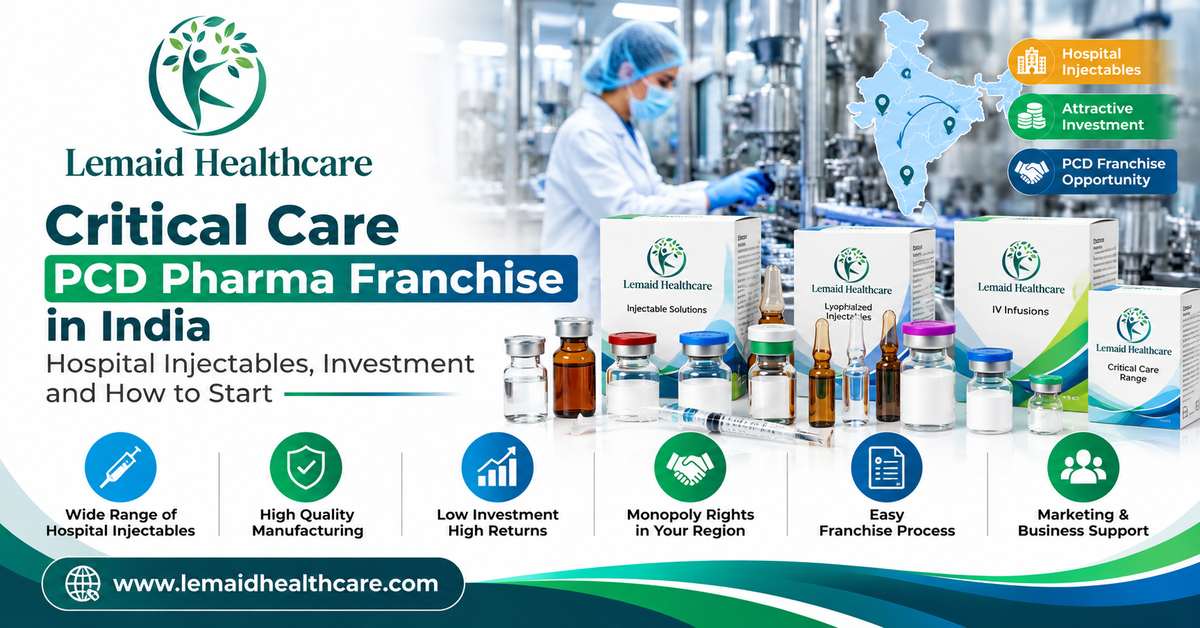
Thinking of starting your own pharma business but not sure which segment to pick? A lot of medical reps and distributors who call us have the same question. Most of them have heard that critical care pays well, but nobody has explained how it actually works from the partner’s side.
So here’s our honest take. Critical care is a little harder to get into than a general medicine range, but the orders are bigger, they repeat often, and once a buyer trusts you, they usually stay. We’re Lemaid Healthcare, and in this guide we’ve covered everything a person thinking about a Critical Care PCD Pharma Franchise in India usually asks us: how the model works, what you can earn from, which products to start with, how much money and paperwork you need, monopoly rights and how to pick the right company.
What Is a Critical Care PCD Pharma Franchise?
PCD stands for Propaganda Cum Distribution. Old term, simple deal. A pharma company gives you the right to promote and sell its branded medicines in an area you both agree on. They make, pack and supply. You build the market, keep stock and deliver.
In a Critical Care Pharma Franchise, the range is mostly injections, like antibiotic vials, IV acid reducers, anti-vomiting injections and iron or vitamin injections. Your buyers are hospitals, nursing homes and the chemists attached to them. You buy at a partner rate and sell within the allowed price, and the difference after your costs is your income.
You don’t need a factory, a brand of your own or years of setup. You need a drug licence, a proper storeroom and the patience to build a few strong buyer relationships.
Why Critical Care Is a Good Franchise Opportunity
The first reason is demand. New private hospitals and nursing homes keep opening, and not only in big cities. Plenty of district towns now have them too, and each one needs a reliable injection supplier. Since infections and surgeries happen all year, sales don’t really have a slow season.
The second reason is order size. One hospital can buy more in a month than ten small chemists, so a partner with even a handful of hospital accounts can have a solid business. And the third is loyalty. Hospitals don’t like changing suppliers once one is working well. If you deliver on time with good stock, the same buyer keeps ordering month after month. That steady repeat business is what makes a critical care injection PCD franchise attractive to so many people.
Who Can Take a Critical Care Franchise?
Medical reps who already know hospital pharmacists are probably the best fit for a critical care franchise opportunity, since half the work is relationships. Existing pharma distributors who sell general medicines can add a critical care range and use the contacts they already have. Chemists near a hospital, pharmacy graduates and first-time business owners can start too, as long as they get the licence and storage right.
You don’t need to be a doctor or have a science degree. You do need a registered pharmacist or a person with the required experience as the competent person on your drug licence, which many partners arrange by hiring one.
How You’ll Get Orders as a Partner:
This is the part people coming from retail don’t expect. You can’t just walk in with a catalogue and leave with an order. Most hospitals buy only from suppliers on their approved vendor list. Some use purchase orders, bigger ones run tenders, and a few have fixed contracts with certain brands.
So your early work is getting onto those lists. The hospital pharmacist or purchase manager usually decides, and they’ll ask for your drug licence, GST details, company documents and sometimes samples. Then they’ll test you with a small order. Deliver it on time with good expiry dates, and the next one is bigger.
Payment works differently as well. Many hospitals pay in 30, 60 or even 90 days. So the margin on paper becomes profit only when the money arrives, after freight, storage, expiry losses and any late payments. Understanding this hospital supply business before you invest saves a lot of stress later.
Lemaid Critical Care Injection Range:
These are the critical care injections new partners usually start with. Each name links to its product page.
| Product | Composition | Used For |
|---|---|---|
| MEROSOFT-1000 | Meropenem 1000 mg | Severe and resistant infections |
| TAZOLEM-4.5 GM | Piperacillin 4 g + Tazobactam 0.5 g | ICU pneumonia, abdominal infections |
| TAZOLEM-2.25 GM | Piperacillin 2 g + Tazobactam 0.25 g | Serious bacterial infections |
| LEMZONE-S 1.5 GM | Cefoperazone 1000 mg + Sulbactam 500 mg | Serious hospital infections |
| LEMCEF-1.5 GM | Ceftriaxone 1000 mg + Sulbactam 500 mg | Hospital infections, after surgery |
| LEMCEF-1 GM | Ceftriaxone 1000 mg | Infections and infection prevention before surgery |
| LEMCEF-S 375 | Ceftriaxone 250 mg + Sulbactam 125 mg | Bacterial infections |
| PANTALEM-40 IV | Pantoprazole 40 mg | Acidity and ulcer prevention in admitted patients |
| RABILEM 20 | Rabeprazole 20 mg | Acid problems in patients who can’t take tablets |
| VOMILEM | Ondansetron 2 mg/ml (2 ml ampoule) | Vomiting after surgery or chemotherapy |
| FERILEM-100 | Iron Sucrose 100 mg | Iron deficiency anaemia |
| COBALEM-2500 | Methylcobalamin 2500 mcg | Vitamin B12 deficiency and nerve support |
You don’t need all twelve on the first day. A couple of ceftriaxone options, pantoprazole IV and ondansetron are usually enough to get a hospital pharmacy talking to you. Meropenem and piperacillin come later, once they trust your stock and your dates.
Critical Care Pharma Franchise Investment
There’s no single figure, and you should be wary of anyone who quotes one without asking about your area. It depends on how many products you pick, the company’s minimum order, your storage and how much credit your hospitals expect. Here’s a rough planning example.
| Expense | Example Amount |
|---|---|
| Opening injection stock | ₹50,000 |
| Storage and basic setup | ₹20,000 |
| Licence and documents | ₹10,000 |
| Transport and delivery | ₹10,000 |
| Product literature and visits | ₹10,000 |
| Money kept aside for repeat orders | ₹30,000 |
| Total | ₹1,30,000 |
It’s an example only, not a Lemaid quotation. If you plan to stock anything that needs a fridge, add the cost of proper cold storage. And look at that reserve line again. With hospitals paying in 30 to 90 days, it’s the line that keeps your business running. Planning your critical care pharma franchise investment around credit, not just stock, is the smart way to do it.
Drug Licence and Documents You’ll Need
Injections are allopathic prescription medicines, so you can’t sell them wholesale without a drug licence. It’s usually issued on Forms 20B and 21B by your state’s drug licensing authority. A franchise letter from a company doesn’t replace it.
| Document | Why It’s Needed |
|---|---|
| Wholesale drug licence (20B and 21B) | Legal permission to sell medicines wholesale |
| PAN card | Tax identity |
| GST registration | Billing hospitals and chemists |
| Premises proof | Rent agreement or ownership papers for your storeroom |
| ID and business papers | To verify you and your firm |
| Competent person details | A registered pharmacist or a person with the required experience |
| Franchise agreement | Written record of your area and terms |
| Purchase invoices | Proof of where your stock came from |
The licensing office will usually inspect your storeroom. It should be clean, dry and out of direct sun, and if you stock anything that needs cold storage, you need a working fridge with a temperature log. Some ICU medicines carry extra legal controls, so check the rules before you ever plan to stock those. Getting your drug licence for a critical care franchise started early, even while you’re still meeting hospitals, saves weeks.
How to Start a Critical Care Franchise Step by Step
Start with a list of the hospitals, nursing homes and surgical centres in your area. Then go and meet their pharmacists. Ask what they go through fastest, whose brands they buy now and whether any supplier has let them down lately. A town full of surgical hospitals will want very different products from one with mostly small clinics.
While you’re doing those rounds, apply for your licence. Then shortlist two or three companies with a proper injectable range. Get their product lists, rates and sample vials, and ask how many days an order takes to reach you. Read the agreement properly before you sign, especially area, payment terms, expiry returns and delivery.
When everything’s in place, place a small first order. Check every box when it arrives, names, strengths, batch numbers, expiry dates and the condition of the vials, and report anything wrong straight away. Then go back to the hospitals, get on their vendor lists and deliver exactly when you say you will. Add products only when an order proves the demand. That’s really how every successful critical care PCD pharma franchise company partnership grows, one hospital at a time.
Monopoly Critical Care PCD Pharma Franchise in India
Monopoly means the company agrees not to appoint another partner for the same products in your area. Other brands can still sell there. It just stops your own company from putting a second partner next to you.
In critical care, that matters more than in most segments. Getting onto one hospital’s vendor list can take months of visits and paperwork. Under a Monopoly Critical Care PCD Pharma Franchise in India, nobody from your own company can walk in after you and offer that hospital a lower rate.
Before you sign, ask for the details. Which exact area? Which products? Is there a monthly purchase target? How long does it last, and how is it renewed? Are government tenders or existing hospital contracts left out? Get every answer in writing, because a phone promise means nothing later.
What to Check Before Choosing a Company
When you compare any hospital injectable PCD franchise in India, quality comes ahead of everything. One bad batch and a hospital pharmacist may never order from you again, and pharmacists talk to each other. Ask where the injections are made and check the labels yourself. Composition, strength, batch number, dates and manufacturer details should all be clear and match the paperwork.
Then supply. Ask how often their main injections go out of stock and how fast a repeat order actually leaves their warehouse. A hospital won’t wait for you. If you run short for a few days, they’ll buy another brand, and it might quietly become their regular one.
Look at the money side too: partner rates, GST, freight, payment terms and the policy on expiry and breakage, all in writing. And notice how the company treats you before you’ve paid. Do they answer calls? Do they send documents when promised? That’s usually the best treatment you’ll ever get, so it should be good.
Common Problems and How Partners Handle Them
Getting into hospitals is slow at first. Most already have suppliers. Partners who succeed don’t try to replace everyone at once. They find the one or two products where the current supplier is weak and start there.
Slow-moving stock is the next problem. Some injections sell every day, others once a month. Start narrow, check your stock every couple of weeks and stop reordering what doesn’t move. Expiry is related. Keep batch-wise records and sell the oldest stock first.
Late payments are the big one. Agree on terms before the first bill, keep a record of what each hospital owes, and don’t let one customer run up too much credit. Storage needs care too, especially in summer. A cool, dry room and a proper fridge for anything that needs it will save you losses. None of these Critical Care Business Challenges are deal breakers. They just need attention from day one.
Why Choose Lemaid Healthcare for Critical Care?
We’ve built our injectable range around what private hospitals and nursing homes reorder most: ceftriaxone and sulbactam combinations, cefoperazone with sulbactam, piperacillin with tazobactam, meropenem, pantoprazole IV, ondansetron, iron sucrose and methylcobalamin. Most of our antibiotic vials come packed with their own sterile water, which hospital staff appreciate.
Partners get monopoly-based rights in their allotted area, along with product literature and help from our marketing team. If you’re looking for a Critical Care Medicine Distributor in India opportunity with a ready hospital range, call or message our team. We’ll send the full product list and rates and tell you whether your area is open.
Conclusion:
Critical care isn’t the easiest way into pharma distribution, but it’s one of the most rewarding once it’s running. Hospitals reorder often, order in bulk and stay loyal to a supplier who never lets them down. The partners who do well start small, get their licence and storage right, build trust with a few hospital pharmacies and grow their range only when real orders ask for it.
If you’re ready to start a Critical Care PCD Pharma Franchise in India, Lemaid Healthcare would be glad to talk. With a ready range of hospital injections, monopoly-based rights and support from our team, we can help you plan your first order and your first few hospitals. Get in touch for the product list and rates.
Frequently Asked Questions:
Q.1 What is a Critical Care PCD Pharma Franchise in India?
It’s a business where you sell a pharma company’s hospital injections in your own area under their brand. They make and supply the products. You build the hospital network and keep the margin.
Q.2 How much investment do I need?
There’s no fixed figure. A small start can be planned around ₹1 to 1.5 lakh, as in our example, but hospital credit terms can push it up. Keep a good reserve for repeat orders.
Q.3 Do I need a drug licence?
Yes. Selling injections wholesale needs a drug licence, usually on Forms 20B and 21B, from your state’s drug licensing authority, plus GST registration.
Q.4 Which products should I start with?
Ceftriaxone injections, pantoprazole IV and ondansetron are a safe start. Add meropenem and piperacillin with tazobactam once hospitals know you.
Q.5 Can I start in a small city?
Yes, if there are enough private hospitals and nursing homes with ICU or surgery. Count them and meet their pharmacists before you invest.
Q.6 What are monopoly rights?
It’s a written agreement that the company won’t appoint another partner for the same products in your area.
Q.7 Does Lemaid Healthcare offer monopoly?
Yes. We offer monopoly-based rights in the allotted area, depending on availability. The area and products are written into the agreement.
Q.8 How do I contact Lemaid Healthcare?
Visit lemaidhealthcare.com, or call or WhatsApp the numbers on the site. Ask for the injectable list, rates and area availability.