

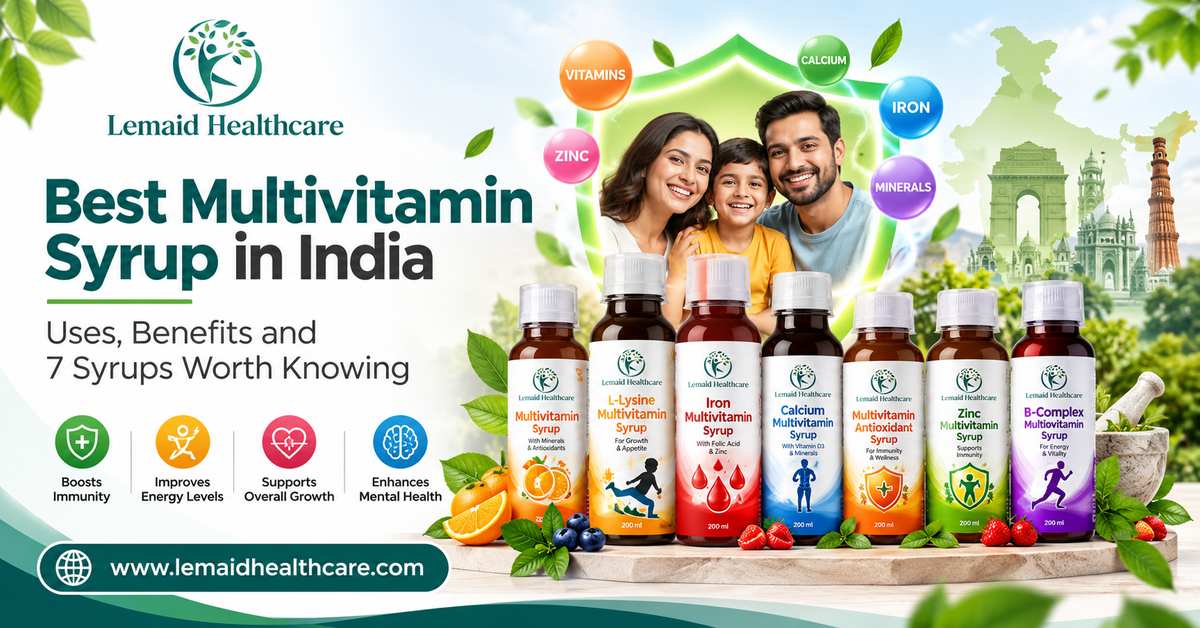
Most families have one somewhere. A bottle at the back of the kitchen shelf, half used, bought the month a child stopped eating properly or a grandparent came home from hospital looking thin. Somebody at the chemist said, “Give him a tonic,” and the bottle went home. Nobody quite remembers what was in it.
That’s the odd thing about the multivitamin syrup. It’s one of the most commonly bought products in any chemist shop, and yet very few people know what separates one bottle from the next. Some are mostly B vitamins to bring back appetite. Some carry iron for low haemoglobin. And then there are the ones with lycopene or coenzyme Q10 on the label, words most customers couldn’t explain if you asked them. So we’ll go through it slowly, the way a patient chemist would, and further down you’ll find the seven multivitamin syrups in our own range at Lemaid Healthcare, with what’s inside each one.
What Is a Multivitamin Syrup?
Strip away the fancy labels, and it’s simple. A multivitamin and multimineral syrup is a bottle of liquid with a bunch of vitamins, and usually, a handful of minerals like zinc or iron dissolved into it. You measure it with the little cup that comes in the box, usually once or twice a day, however much the doctor or the label says.
People reach for syrups over tablets for simple reasons. Children won’t swallow tablets. Grandparents often won’t either, or they’ll hold one in their mouth for a full minute before giving up. Someone just out of hospital, whose stomach still feels delicate, tends to manage a sweet liquid far better. And a paediatrician can tell a mother “half a cup for the little one, a full cup for his sister”, which is hard to do with a tablet.
One thing it isn’t is a replacement for food. A spoonful of tonic won’t make up for skipped meals day after day. It fills small gaps. That’s all, and honestly, that’s plenty.
Who Usually Needs a Multivitamin Syrup?
Children are the biggest group. A four-year-old who pushes his plate away every night, a girl who hasn’t been hungry since her fever last month, a boy who’s suddenly the shortest in his class photo. Plenty of them go home from the paediatrician with a tonic. A multivitamin syrup for kids is usually on the milder side, often with lysine and B vitamins aimed at getting them eating again.
Older people come next. They just don’t eat the way they used to, chewing gets harder with loose teeth, and the body isn’t as good at pulling vitamins out of food any more. When a doctor spots that, a daily syrup is an easy thing to add.
Then there are people getting back on their feet. Anyone who’s had typhoid or dengue knows the weeks afterwards, when you’re technically better but can barely climb the stairs. Doctors often write a tonic for that stretch and after surgery or a long round of antibiotics too.
Women make up another big share. Heavy periods drain iron month after month, and pregnancy and breastfeeding ask the body for more folic acid, iron and calcium than usual. Gynaecologists write iron-based syrups for exactly this, mixed with other vitamins.
And plenty of adults simply feel run down. Breakfast is a cup of tea on the way out, lunch is whatever’s near the office, and dinner comes late. By four in the afternoon they’re yawning at the desk. A syrup won’t fix that routine, but a doctor may suggest one while they sort out their meals.
Types of Multivitamin Syrups
Walk along a chemist’s tonic shelf, and the bottles look alike. What’s inside isn’t.
The oldest kind on that shelf is the appetite tonic. It’s mostly B vitamins, which the body needs to get energy out of food, with L-lysine often added for growth. This is the one mothers ask for when they say they want “something to make him eat”.
Next to it you’ll usually find the iron syrups, which some chemists still call blood tonics. Iron sits at the centre, with folic acid and vitamin B12, and often calcium and vitamin D3 thrown in. Doctors write these when a blood report shows low haemoglobin.
The broad multivitamin and multimineral syrups are the general-purpose ones, with a long list of vitamins plus zinc, selenium, iodine, magnesium and a few others. They’re meant for everyday top-ups rather than one particular problem.
Then come the antioxidant syrups, with ingredients like lycopene, the red colour in tomatoes, or coenzyme Q10, something the body’s cells use to make energy. Adults and older people tend to buy these.
Last, and worth a separate mention, is the Sugar-Free Multivitamin Syrup. Most tonics are sweet enough to please a child, which is a real problem if you’re diabetic. Sugar-free versions exist for exactly that reason, and the label will say so clearly.
Benefits of Taking a Multivitamin Syrup
The first thing most mothers notice is the plate. When B vitamins are low, food just doesn’t seem interesting, and a few weeks of a B-complex syrup often brings the hunger back, especially in children after an illness. “He finished his whole dinner last night” is usually how the news arrives.
Energy tends to come back with it. The body uses B vitamins to turn food into fuel, so when they’re running short, people feel flat. Topping them up won’t turn anyone into an athlete, but the slump after lunch often feels a little lighter.
For people with low haemoglobin, an iron syrup with folic acid and B12 does real work. Those three are what the body needs to build healthy red blood cells, and the doctor can see the change in the next blood test.
Vitamins A, C and E, along with zinc and selenium, help keep the body’s defences going and protect cells from damage. Nobody can promise you won’t catch the next cold. But someone who’s short on these tends to get knocked down more easily and takes longer to bounce back, which is why immunity sits high among the multivitamin syrup uses doctors have in mind.
And for anyone who simply can’t swallow tablets, a syrup makes regular supplementation possible at all.
How to Choose the Right Multivitamin Syrup
Picture a man at the chemist’s counter asking for “the best multivitamin syrup you’ve got”. A good chemist won’t just hand him the most expensive bottle. He’ll ask who it’s for.
That question matters more than anything on the label. A child who won’t eat, a pregnant woman with a low blood count and a sixty-year-old diabetic need three quite different bottles, and a doctor or pharmacist can point you to the right type in a minute.
Once you’ve got the right type, turn the box over. A decent product lists every vitamin and mineral along with how much of each is in a dose. If all it says is “multivitamin with antioxidants”, you’re guessing.
Look for the age range too, since children’s and adults’ doses aren’t the same. If diabetes is part of the picture, go sugar-free. And if someone in the house already takes an iron or calcium tablet, mention it to the doctor, because doubling up isn’t a good idea.
Then there’s taste, which people underrate. A syrup that a six-year-old spits into the sink every morning isn’t helping anybody, so a flavour he’ll actually swallow is worth a lot.
Things to Keep in Mind
Taking two spoons instead of one won’t get anyone better twice as fast. Some vitamins, A and D in particular, can pile up in the body if taken in big amounts for months, so the dose on the label, or the one your doctor gave, is the one to stick to.
Most people never notice any multivitamin syrup side effects at all. Iron syrups are the exception. They can turn stools dark, which frightens people the first time but is usually harmless, and now and then they upset the stomach. Taking them after food helps.
Keep the bottle somewhere high, because to a toddler a sweet syrup looks exactly like juice. And if you’re pregnant, breastfeeding or already on treatment for something, have a word with your doctor before starting any supplement.
7 Multivitamin Syrups from Lemaid Healthcare
If you’ve been looking up Top Multivitamin Syrup Brands in India, here’s what we make ourselves at Lemaid Healthcare. Seven syrups, each meant for a slightly different person. The ingredients below are taken from our product pages.
1. LEMAID-Q10 Syrup:
Think back to that sixty-year-old diabetic at the chemist’s counter. This is the bottle we’d point him to. It’s sugar-free, comes in a 200 ml pack, and puts coenzyme Q10 and lycopene together with vitamin B12, vitamin D2, vitamins A and E, riboflavin, pyridoxine and thiamine. The minerals include zinc, magnesium, copper, iodine and selenium. Adults who want antioxidant support without the sugar get on well with it.
2. LYCOMEAL Syrup:
Lycopene is the star here, backed by multivitamins, multiminerals and antioxidants. LYCOMEAL suits the tired adult who skips meals and needs a general top-up, and lycopene tonics like this are among the ones doctors reach for most often.
3. LEMPLEXT-FORTE Syrup:
Some people need a bit of everything. A woman who’s been losing iron through heavy periods for years, say, or someone who spent a month in bed after an illness and whose bones suffered along with their blood. LEMPLEXT-FORTE carries iron, calcium, vitamin D3 and vitamin B12, along with antioxidants, multivitamins and multiminerals, all in one bottle.
4. LEMVIT-HB Syrup:
LEMVIT-HB is our haematinic syrup. Iron, folic acid and vitamin B12 do the main job here, with calcium, vitamin D3, antioxidants and other vitamins and minerals alongside. You’ll see it written for low haemoglobin, iron deficiency, constant weakness and pregnancy support, at whatever dose the doctor sets.
5. LEMPLEX Syrup:
Our 100 ml everyday syrup, and the list on the box is a long one. L-lysine, the B vitamins (thiamine, riboflavin, pyridoxine, niacinamide and D-panthenol), vitamins A, C and E, then zinc, manganese, iodine, selenium and molybdenum. Daily nutrition, growth and appetite, all covered in one go.
6. LEMPLEX-L Syrup:
This is the “make him eat” bottle. B-complex with L-lysine in a 200 ml pack, given to children who’ve lost interest in food or aren’t growing as they should and to adults getting their strength back after an illness or surgery.
7. LAMPLEX Syrup:
A plain, dependable multivitamin, multimineral and antioxidant syrup, for families who just want one good tonic on the shelf for everyday use.
Multivitamin Syrup PCD Pharma Franchise in India
Ask any chemist which tonic he never lets run out, and he’ll point at the multivitamin shelf. Paediatricians write these syrups for children who won’t eat, physicians write them after fevers and infections, gynaecologists write the iron-based ones, and a good share sell straight over the counter to parents and older customers who just ask for “a good tonic”. Very few products move through that many hands, in every month of the year.
That’s what makes a Multivitamin Syrup PCD Pharma Franchise in India such a steady line to build on. You get the right to market and sell a company’s branded syrups in your area, the company handles the manufacturing, and you look after doctors, chemists and supply. There’s no seasonal dip like you’d see with cough syrups, and once a doctor starts writing your tonic for his regular patients, the reorders tend to look after themselves.
Getting started isn’t complicated, but the paperwork comes first. You’ll want a wholesale drug licence, usually on Forms 20B and 21B, from your state’s drug licensing office, plus GST. One catch with tonics is that some are registered as health supplements under FSSAI rather than as medicines, so ask the company which of its syrups fall where. For a first order, three or four syrups that each do something different is plenty, maybe an appetite tonic, an iron syrup and an antioxidant one. You can widen the range once the local doctors know your face.
Two practical things are worth planning for. Syrup bottles are heavy, so freight costs more than for strips of tablets. And a bottle that tastes bad simply won’t get a second order, so try the samples yourself before you sign.
Lemaid Healthcare‘s syrup range runs to more than 40 products, with the seven multivitamin syrups above at its centre. We back our partners with promotional support from an experienced marketing team and a satisfaction guarantee, and you can call or message us for the full list and current rates.
Monopoly Multivitamin Syrup PCD Pharma Franchise in India
Monopoly is usually the first thing a new partner asks about, and for good reason. With a Monopoly Multivitamin Syrup PCD Pharma Franchise in India, the company agrees not to appoint another partner for the same products in your area. Nobody from the same company can undercut you on your own brand after you’ve done the hard work of getting doctors to write it.
It doesn’t stop other brands from selling there, of course. What it guards is your own sweat, all those visits it took to get your tonic onto a doctor’s prescription pad.
So before you sign anything, have it written down. Is “your area” a whole district, one city, or a few towns? Which syrups are covered, and whether new ones added later will be included. How long the rights last, and whether there’s a monthly target attached to them. Look at any target with a slow month in mind, not just a busy one.
Lemaid Healthcare offers monopoly-based opportunities to its franchise partners. Just tell our team the area you have in mind, and they’ll check whether it’s free and walk you through the terms.
Conclusion:
Go back to that half-used bottle at the back of the kitchen shelf. Somebody bought it because a child stopped eating, or a parent was tired all the time, or someone came home from hospital looking smaller than when they went in. The family wanted to help, and a good syrup can help, as long as it’s the right one for that person.
Which really means asking “who is this for?” before “which brand?”. A picky five-year-old, a pregnant woman with a low blood count, a diabetic grandfather and a worn-out office worker all need something different. Read the box, check it suits their age, pick sugar-free where sugar is a worry, and don’t go over the dose.
And keep expectations sensible. A tonic works alongside proper meals and enough sleep, not instead of them, and the doctor who knows the patient is still the best guide.
If you’re looking for the Best Multivitamin Syrup in India for your family, or want to start a multivitamin syrup PCD pharma franchise in India with monopoly rights, Lemaid Healthcare’s seven syrups cover appetite, iron, antioxidants and everyday nutrition. Have a chat with your doctor about which one suits you, or ring our team for product and franchise details.
Frequently Asked Questions:
Q.1 What is the best multivitamin syrup in India?
Ans. There isn’t one best syrup for everyone. It depends on who’s drinking it. Children who won’t eat usually do best on a B-complex and lysine syrup, low haemoglobin calls for an iron one, and diabetic adults need sugar-free. Your doctor will know which fits.
Q.2 Can adults take multivitamin syrup?
Ans. Yes. Plenty of syrups are made with adults in mind, and they’re especially handy for older people, anyone recovering from an illness, and those who just can’t get tablets down.
Q.3 Is multivitamin syrup good for children?
It can be, for kids who eat like sparrows, who’ve been ill recently or who seem to be growing slowly. Let the paediatrician set the dose, and pick a syrup that’s meant for your child’s age.
Q.4 When is the best time to take a multivitamin syrup?
Most people take it after a meal. It’s easier on the stomach that way and the body absorbs it better. If your label or doctor says something different, go with that.
Q.5 Can a multivitamin syrup increase appetite?
Often, yes. Syrups with B vitamins and L-lysine are the usual choice for this, and many parents see a difference within a few weeks, mainly when a vitamin shortage was behind the poor appetite in the first place.
Q.6 Are there sugar-free multivitamin syrups for diabetics?
Yes. Our LEMAID-Q10 Syrup has no sugar in it. Even so, a diabetic should read the label and check with the doctor before starting.
Q.7 How do I start a multivitamin syrup PCD pharma franchise in India?
Sort out a wholesale drug licence and GST first, and find out whether the syrups you want are medicines or FSSAI supplements. Then compare two or three companies on taste, labels, rates and how reliably they deliver, and start with a handful of syrups that each do a different job. Our team at Lemaid is happy to send the list and rates whenever you’re ready.
Q.8 Does Lemaid Healthcare offer a monopoly multivitamin syrup PCD franchise?
Yes. Lemaid offers monopoly-based opportunities, so another Lemaid partner can’t sell the same products in your area. The area, products, duration and any target should all be written into the agreement.