

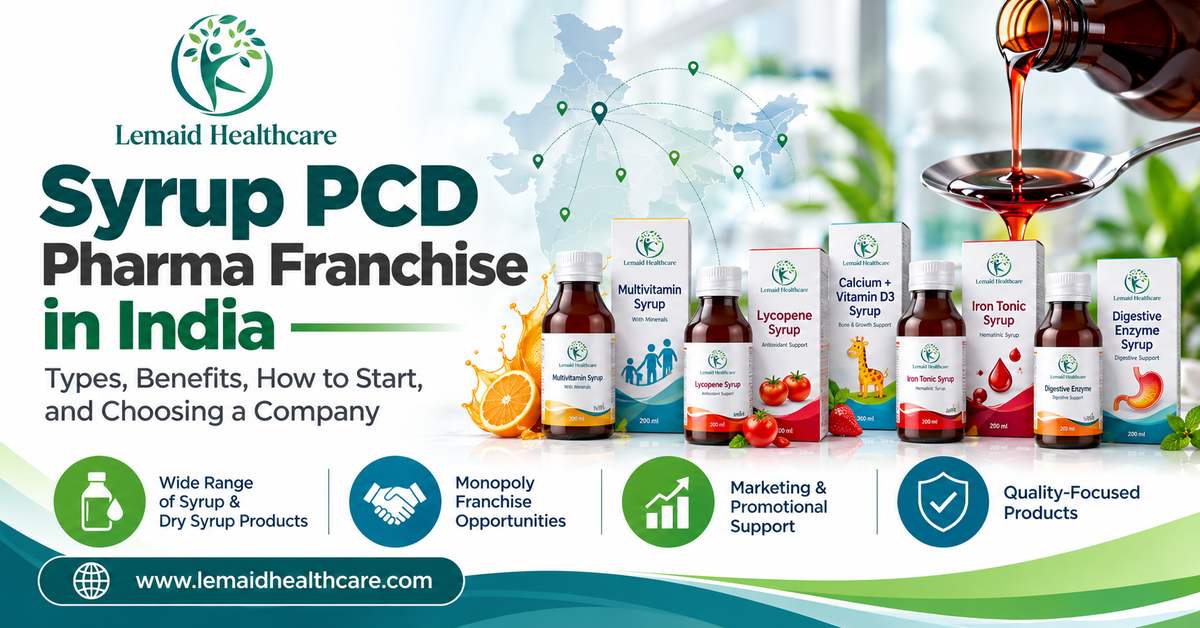
Look behind any chemist’s counter and you’ll find a whole shelf of bottles. Cough syrups at the front in winter. Antacids that never really leave. Tonics and multivitamins for kids who “don’t eat properly,” as every mother says. A row of dry syrup cartons for the child specialist down the road. Syrups move every day, in every season, and that’s the reason so many people choose a Syrup PCD Pharma Franchise as their way into the pharma business.
They’re also trickier than tablets in a few ways. Bottles are heavy. Some leak. Children refuse anything that tastes bad. And after some contaminated cough syrup cases made headlines, doctors and chemists have become a lot more careful about which brands they trust. So this guide goes through the types of syrups you’ll sell, who buys them, what’s good about the business, how to start, and how to pick a company that won’t let you down.
What Is a Syrup PCD Pharma Franchise?
PCD stands for Propaganda Cum Distribution. A pharma company lets you sell its syrups under its brand name in a fixed area. They make the products, fill the bottles, and send them to you. You take them to doctors, chemists, and hospitals in your area, and you keep the difference between what you paid and what you sold for.
You don’t need a manufacturing unit or your own product licenses. A drug license, some working capital, and regular visits to doctors are what it takes. The company handles the rest.
Types of Syrups in a Syrups PCD Pharma Franchise in India
Ask for the product list of any company offering a Syrups PCD Pharma Franchise in India, and it’ll usually fall into a handful of groups.
Cough syrups come to mind first, and for good reason. Dry cough, wet cough, blocked nose, sneezing. There’s a bottle for each. From October to February they practically sell themselves, and by April they’re gathering dust. Plan them like the seasonal product they are.
Antacids are the opposite. Acidity doesn’t care what month it is, and neither does gas after a heavy meal. Doctors write these for teenagers and grandparents alike. The thick suspensions that coat the stomach are some of the most reordered bottles on any chemist’s shelf.
Then come the tonics, and in India this is a big one. “He doesn’t eat anything” is probably the most common thing a child specialist hears from mothers, and a multivitamin syrup is often the answer. Adults reach for one after a long fever. Iron, calcium, and vitamin D syrups belong to the same family, and both child specialists and gynecologists write them.
Dry syrups work a little differently. You get a bottle of powder and a small pack of sterile water, and the two are mixed before the first dose. Most are children’s antibiotics, like amoxicillin with clavulanic acid or cefpodoxime. Why powder? It keeps far longer on the shelf than a ready liquid. Once mixed, it’s good for about a week, and then it goes in the bin.
Children’s syrups for fever, allergy, and loose motions fill in the gaps. A few companies add ayurvedic or herbal syrups for cough, digestion, and immunity as well.
Who Buys Syrups?
Child specialists, more than anyone. A two-year-old isn’t going to swallow a tablet, so nearly everything on a pediatrician’s prescription is a syrup, suspension, dry syrup, or drop. Get two or three busy child specialists writing your brand, and you’ve got a business.
General physicians write their share too, mostly for coughs, acidity, and tonics. Older patients like syrups because a spoonful goes down easier than a big tablet. Gynaecologists write iron and calcium syrups for pregnant women all the time. Nursing homes and hospitals keep the common ones in stock for admitted patients and for discharge.
And then there’s the counter. A lot of tonics, antacids, and simple cough syrups are bought straight from the chemist without a prescription, so the chemist’s own recommendation matters a lot in this segment.
Benefits of a Syrup PCD Pharma Franchise in India
Demand Every Day, Every Season:
Cough syrups peak in winter. Antacids sell all year. Tonics pick up in summer when children lose their appetite in the heat, and after illnesses. Antibiotic dry syrups rise in the monsoon and winter. There’s no real dead season for a well-mixed syrup range.
Children Mean Repeat Customers:
Families with small children are at the doctor often. Once a child specialist finds that kids take your syrup without a fight, he’ll keep writing it, and parents will keep coming back for the same bottle the next time the child falls ill.
Strong Counter Sales:
Many syrups don’t need a prescription. That gives chemists a reason to push your brand on their own, especially tonics and antacids, which means sales you didn’t have to visit a doctor for.
Easy to Combine With Other Ranges:
Syrups fit naturally alongside tablets and drops. A partner selling syrups to a pediatrician can easily add drops and dry syrups, and a partner selling to physicians can bring tablets from the same company. One relationship, several products.
Lower Investment Than Manufacturing:
Setting up a liquid manufacturing line with proper quality testing takes a lot of money. As a franchise partner, you skip all of that. Your main costs are stock, your license, travel, and working capital.
How to Start a Syrup PCD Pharma Franchise in India
Step 1: Visit Clinics and Chemists in Your Area:
Spend a couple of weeks just talking to people. Ask child specialists what they write most. Ask chemists which syrups fly off the shelf and which brands customers ask for by name. Note what’s often out of stock. That list tells you what to order.
Step 2: Get Your Drug License and GST:
You’ll need a wholesale drug license from your state drug licensing authority before you can buy or sell medicines. The rules ask for proper storage space and a qualified or experienced person, and there’s usually an inspection. Syrups take up a lot more room than tablets, so plan your storage space with that in mind. GST registration is needed too.
Step 3: Compare Two or Three Companies:
Look at the range, the quality documents, how the bottles are packed for transport, and how fast repeat orders arrive. Ask for samples and actually taste the children’s syrups. If you wouldn’t want to drink it, a four-year-old definitely won’t.
Step 4: Put Products and Territory in Writing:
Agree on the products, your exact area, any monopoly terms, purchase targets, and how long the deal lasts. Get it all into the franchise agreement before your first order.
Step 5: Start Small and Watch the Seasons:
Order a small first lot of the syrups doctors in your area already write. Time your cough syrup stock for the start of winter, not the middle of it. Then keep visiting your doctors and keep chemists stocked.
How to Choose the Best Syrup PCD Pharma Company in India
Every company claims to be the best syrup PCD pharma company in India. A few things actually separate them.
Quality and Ingredient Testing:
This matters more for syrups than for almost anything else. In recent years, a few cases of contaminated cough syrups shook the whole industry, and regulators have tightened the testing of ingredients since then. Doctors remember those stories. A good company will tell you where its syrups are made and how its raw materials are tested, and it’ll share its manufacturing license and quality certificates without hesitation.
Taste, Texture, and Packaging:
For children’s syrups, taste decides everything. A bitter syrup gets spat out, the mother complains, and the doctor switches brands. Look at the packaging too. A proper measuring cup, a cap that seals well, and a clear label make a difference to both the parent and the chemist.
Safe Transport:
Syrup bottles are heavy and can crack or leak on the way. One broken bottle can ruin a whole carton of labels. Ask how the company packs syrups for dispatch and who pays when a box arrives damaged.
Supply and Range:
A wide range lets you cover cough, gastro, tonics, and dry syrups from one company. But a wide range is useless if the products run out. Ask how often the main syrups go out of stock, especially cough syrups in peak winter.
Monopoly Syrup PCD Franchise
A Monopoly Syrup PCD Franchise means the company won’t appoint another partner for the same products in your area. It protects you from someone else selling the same brand next door. Other syrup brands will still be around, of course.
Get the area, products, duration, and any monthly purchase target written down. Be careful with targets for seasonal products. A cough syrup target that’s easy in December can be impossible in May.
Licenses and Documents Required
The main document is the wholesale drug license, usually on Forms 20B and 21B, from the state drug licensing authority. You’ll need storage space of the size the rules require and a registered pharmacist or someone with the right experience in drug sales.
Companies will also ask for your GST registration, PAN card, Aadhaar or other ID, address proof for your premises, bank details, and business registration papers. Rules can differ a little between states, so check with your local licensing office before applying.
Investment for a Syrup PCD Pharma Franchise in India
There’s no fixed figure. It depends on how many syrups you pick, how many bottles of each, and the company’s minimum order quantity.
Freight deserves a special mention here. Syrups are heavy and bulky compared to tablets, so transport costs more per order. Factor that in when you compare rates. You’ll also spend on travel, samples, and visual aids, and you’ll need money for credit, since chemists and hospitals often pay a few weeks after delivery.
Seasonal planning helps a lot. Cough syrup bought in September sells through the winter. The same order placed in March sits in your storeroom for months.
Managing Syrup Stock:
Keep syrups in a cool, dry place, away from direct sunlight. Heat can affect some liquids, and bottles stacked too high can crack at the bottom of the pile.
A simple register with each product’s batch number, expiry date and quantity, checked every month, saves a lot of trouble. Send out the earliest expiry first. Keep an eye on seasonal products in particular, because a cough syrup that didn’t sell this winter may be close to expiry by next winter.
Why Choose Lemaid Healthcare for Syrup PCD Franchise?
Lemaid Healthcare runs on its own research and development, and we don’t carry any debt. That might sound like a dull detail, but it means our money goes into products and supply instead of loan repayments. Our marketing team knows this business well, and partners get promotional support, monopoly-based terms and a satisfaction guarantee from us.
On the liquid side, we’ve got more than 40 syrups and 12 dry syrups. Cough and cold, gastro, tonics, children’s antibiotics. Here are a few:
| Product | Composition | Pack |
|---|---|---|
| Medkuff-D Syrup | Dextromethorphan HBr 10 mg, Phenylephrine HCl 5 mg, Chlorpheniramine Maleate 2 mg | 100 ml |
| Lemcid-OS | Sucralfate and Oxetacaine suspension | 200 ml |
| Lemplex Syrup | Multivitamin and multimineral with L-Lysine | 100 ml |
| LEMTRAM-P | Iron, calcium, vitamin D3 and vitamin B12 with multivitamins and minerals | Ask for pack |
| Amoxigate-DS Dry Syrup | Amoxycillin 400 mg and Clavulanic Acid 57 mg per 5 ml | 30 ml with sterile water |
| PODCRED-CV 50 | Cefpodoxime Proxetil 50 mg and Potassium Clavulanate per 5 ml | 30 ml with sterile water |
Picture a normal Monday. Morning at a child specialist’s clinic with Amoxigate-DS. Noon at a physician’s with Medkuff-D and Lemcid-OS. Evening at a chemist’s shop with Lemplex for his counter. One company, one supplier, one set of accounts.
Want the full list? Call or message our team for rates, MOQ and whether your area is still free.
Conclusion:
Walk into ten chemist shops and you’ll find syrups in all ten. Child specialists write them all day. Plenty of customers don’t even bother with a doctor and just ask the chemist for “something for cough”. Very few products in pharma move like this, through so many kinds of buyers, all year round.
Getting it wrong is easy, though. A syrup that tastes bad gets spat out, and the mother tells the doctor. A cracked bottle leaks over a whole carton. Run out of cough syrup in the second week of December and the chemist won’t wait for you. And after the cough syrup scares of the last few years, doctors ask harder questions about where a syrup was made.
None of it is hard to handle. Start with the handful of syrups doctors near you already write. Get your cough syrups in before the cold sets in, not after. Leave some money in the bank for freight and reorders, because syrups cost more to move than tablets. When those first products are selling, dry syrups, drops and tablets from the same company slot in easily.
If a Syrup PCD Pharma Franchise in India is what you’re after, Lemaid Healthcare has 40+ syrups and 12 dry syrups, with monopoly-based terms and marketing support behind them. Talk to our team and we’ll send the full list and tell you if your area is open.
Frequently Asked Questions:
Q.1 What is a syrup PCD pharma franchise?
Ans. A company gives you the right to sell its syrups, under its own brand, in an area that’s fixed in the agreement. They handle the manufacturing. Your job is doctors, chemists and supply.
Q.2 Which syrups sell the most?
Ans. Depends on the month. Cough syrups lead in winter. Antacids sell steadily all year, and so do multivitamin and iron tonics. Through child specialists, antibiotic dry syrups move well.
Q.3 What is a dry syrup?
Ans. It’s a powder in a bottle. The chemist or parent adds water before use. Kids’ antibiotics are usually sold this way since powder keeps longer on the shelf. After mixing, most are good for about a week.
Q.4 Which licence is needed for a syrup PCD franchise?
Ans. Same as any other medicine: a wholesale drug licence from your state’s licensing authority, and GST. Just make sure your storage space is big enough, because bottles take up room.
Q.5 Is monopoly available in a syrup PCD franchise?
Ans. Yes, with many companies. Lemaid Healthcare offers monopoly-based opportunities too. Get the area, products, any targets and the duration in writing.
Q.6 Why does freight cost more for syrups?
Ans. Weight and size. A carton of syrup bottles is much heavier and bulkier than the same value of tablet strips, so transport costs more. Add freight before you compare rate lists.